
Tell us about The Lion & The Deathless Dark. Where is this book positioned in the series and what can we expect?
The Lion and the Deathless Dark is the penultimate book in the Crowns of Nyaxia series, which is surreal to write after so many books! The series is divided up into three duets, and Lion is the first book in the Bloodborn Duet. So, for folks who have been reading along as the series has progressed, you’ll start to see a lot of plot threads that have been simmering for several books come together! However, we’re also meeting a new main character and the world has changed a lot since the last Crowns of Nyaxia novel, so this book is also accessible to readers who have not read the previous books. It’s a dark, twisty, action-packed ride, and I hope both new and returning readers love it as much as I loved writing it!
You started out your career self-publishing and selling books on Etsy. What made you choose the indie path first?
Even now, a big chunk of my career is independent! I’m really passionate about self-publishing and while there are of course pros and cons to both publication paths, I’m so grateful that I’ve built the career path that I did and that I’ve been able to maintain that independent aspect as my career has progressed. I originally was attracted to self publishing for two main reasons. One was that I had a pre-existing interest in entrepreneurship and a background in design and marketing, so I thought it was a good match to my skillset. Two was that my primary goal was to make a sustainable, long-term living from authoring, and from the research I’d done, I felt that seemed more realistically attainable as a midlist author via self publishing. I was okay with sacrificing some of the big trade offs of forgoing trad publishing (ie, not being in bookstores, not being on bestseller lists, and generally being less well-known in the literary world) in pursuit of that goal.
What did you learn as a self-published author that has been valuable as your career has progressed?
So many things! I think the biggest was that I learned how to be my own “gatekeeper.” Meaning, in traditional publishing, there are lots of “gatekeepers” who are looking at your book from a reader-focused perspective – editors and agents look at a manuscript and ask themselves, “Who is this book for? Why will these readers like it? What else do these readers like?” In self-publishing, authors need to learn how to do this for themselves, even if what we do with the answers might be different. I learned how to look at my books from a reader-focused perspective and really intentionally understand what I want a reader to love love love about that story. This is often treated as a marketing skill, but I’ve found it’s a very important craft skill as well (you want to write the best book you can possibly write for your reader!), and I think it’s made my books much better.
Looking back, what do you think was the most important decision you made as an early indie author?
I thought about this for a while and I really think it’s the same as my previous answer! The first book where I really evaluated it from a reader perspective and thought very specifically about what I wanted people to remember about the book in one year was Daughter of No Worlds, which ended up being the book that ultimately allowed me to quit my day job. I think that intense focus on the story and specifically what I wanted to resonate about it both created a better book and gave me a very strong foundation for marketing it to the readers who would most enjoy it.
Crowns of Nyaxia found readers organically before becoming a massive BookTok success. How did you approach finding and connecting with readers in the beginning?
This is also going to be something of an extension of my previous two answers. The first step for me is always figuring out who the reader is for the book and why they’re going to love it. The next step is, of course, bringing it to them. I have never done a lot of paid advertising (partly out of laziness!). But I did use social media extensively to market my books and test out different hooks, see what scenes resonated with readers, etc. I did this especially in the lead-up to publishing The Serpent and the Wings of Night, which did end up going somewhat viral later – I’m not sure if this is a direct cause-and-effect, but I imagine it probably did have some impact!
I did this while focusing almost exclusively on my books. I see some newer authors who are intimidated by social media because they think they need to essentially become an influencer. While I know authors who enjoy using social media this way, and sometimes I did engage online authentically as myself, I very rarely made my content about me as a person. Especially on TikTok, I focused exclusively on my books.
What are some misconceptions aspiring authors have about self-publishing?
I’m glad that there are fewer than there used to be! I think self-publishing is seen as a much more “legitimate” and viable path to new authors now than it as ten or even five years ago. That said, it really grinds my gears when people assume that self-publishing is a lesser alternative to traditional publishing, and there’s no reason to choose it unless you tried and failed to break into traditional publishing. This is just objectively untrue. They are very different paths and there are lots of reasons why an author might choose one or the other, but neither is “worse” than the other.
When did things really start taking off?
Most people became aware of my work when The Serpent and the Wings of Night went viral in late 2023, so that was one a major turning point in my career! However, I was already a full-time author before that. My previous series, the War of Lost Hearts Trilogy, slowly but steadily gained a readership and ultimately allowed me to quit my day job in late 2021. It’s hard to pinpoint a “turning point” there because that readership growth was very slow and organic, but I’m grateful every day for the readers who found my books and stuck with them back then. I owe my career to them!
How did your life change after BookTok discovered the series?
It was truly surreal when Serpent went viral. It took a few months after the book was published for the virality to pick up, and I remember somewhere around November or December 2022 looking at the spike in sales and thinking, “Wow, what an interesting fluke!” I never would have guessed that the momentum would keep up! I’m so grateful for the readers who connected with the book and then proceeded to talk about it to others.
I was actually pregnant with my first child around this time, so it was a period of my life with lots of change! I was very focused on getting the next two books in the series, The Ashes and the Star-Cursed King and the standalone spin-off Slaying the Vampire Conqueror, done before I had my son, which was pretty stressful, but it also meant I had something to creatively focus on. I remember looking back at the end of 2023 and thinking about how surreal it was that my life had changed so drastically over the course of one calendar year.
You’ve experienced both the independence of self-publishing and the reach of a major publishing partner. What has surprised you most about each path?
I had a number of surprises going into traditional publishing for sure! One of the biggest was around timelines. Traditionally published books generally come out at a much slower cadence than self-published books, and this was especially true when I was first coming up in self-publishing, when the general consensus was that publishing “only” three-to-four books a year was “slow.” I never did get to the point where I was publishing four books a year, but I did eventually build an efficient system with my various collaborators – beta readers, editors, proofreaders, formatters, etc – which meant that I could go from drafting to editing to formatting to publication very quickly by working on multiple phases at the same time.
Coming from this system, I naively thought that the deadlines in the traditional world would feel downright relaxed. I couldn’t have been more wrong (and I owe my trad colleagues an apology for ever even thinking this)! Both traditional and self-published authors are used to working under very intense deadlines. It’s just that the “machines” around both of these paths are so drastically different that it results in very different publication cadences.
Have you begun to think about what comes next as you move towards the end of the series?
Yes, and I’m very excited! I actually have my next book after the Nyaxia finale all outlined and ready to go as soon as I can devote the attention to it. It’s quite different from anything I’ve ever written before, which is important to me, because I never want to just get stagnant writing the same story over and over again. Still, after eight (!) books in the Crowns of Nyaxia world, it will be a bit bittersweet to move on!
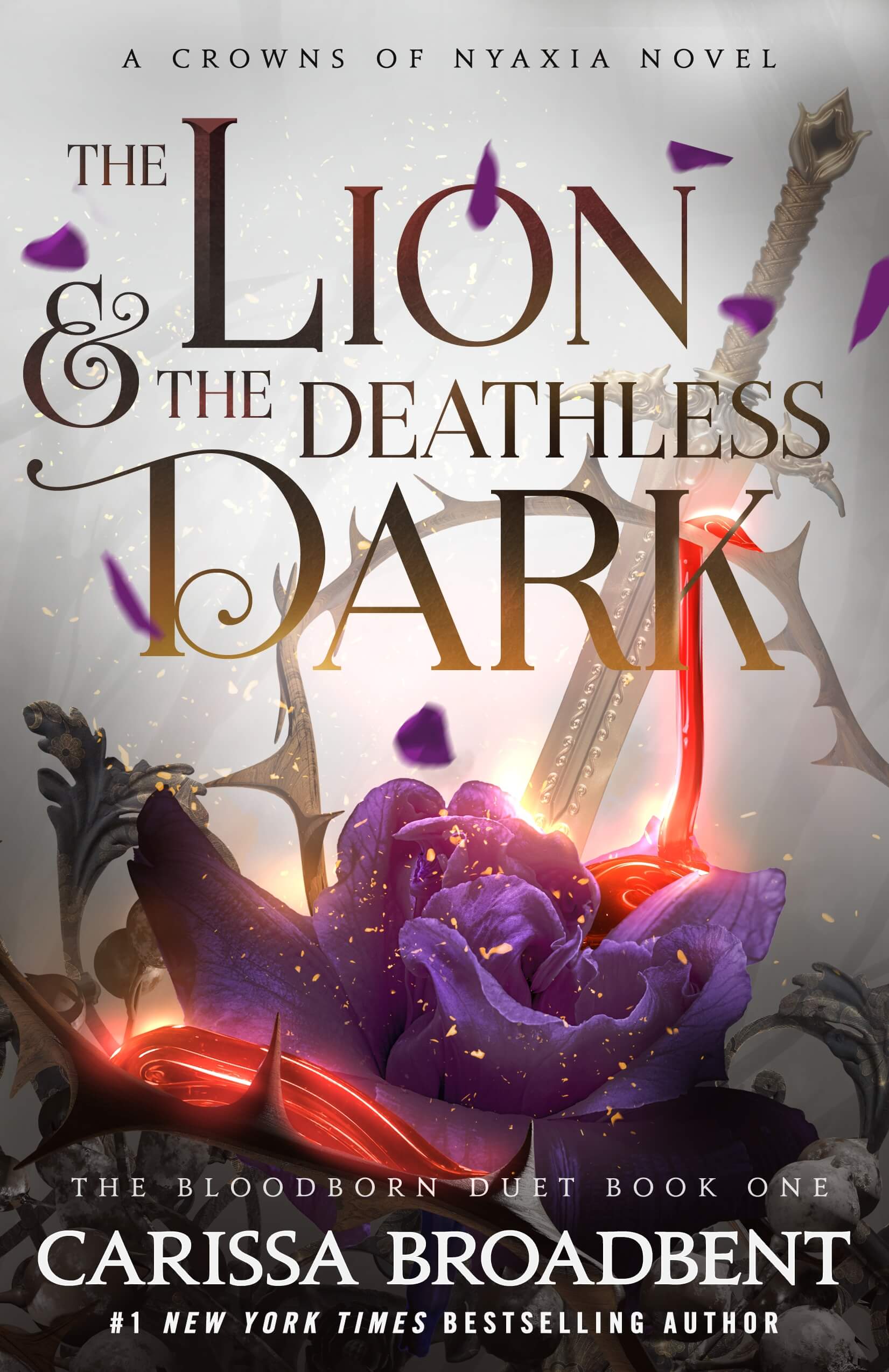
The Lion & The Deathless Dark by Carissa Broadbent
Under an endless night sky, war between humans and vampires has destroyed the world. Kyrene survives working as a bounty hunter, with a sword blessed by the goddess of justice. Following an overwhelming loss, Kyrene commits a crime that means both mortals and gods will be hunting her. Out of desperation and a chance at revenge, Kyrene makes a deal with her enemy Septimus, a charming vampire prince. He gives her one last job–to kill the gods. Together they must steer clear of prophecies and curses while hunting the ultimate marks. Though they are working together, Septimus is keeping dangerous secrets that could hurt them both. Most dangerous of all are Kyrene’s feelings for Septimus. Her growing attraction won’t stop her from getting her revenge and killing the goddess of vampires.
Buy the book now: Bookshop.org | Amazon


Leave A Comment